Wednesday, 11 May 2011

Smoky Noodle Soup


In Edinburgh, the Spring/Summer weather has not really settled in yet. This soup was a perfect warmer quickly made on return from the library. At the last minute, the only fish we could buy was raw smoked salmon, which was less overpowering than I'd thought it would be, and worked well with fennel.

Recipe (serves 4)

4 Spring onions
1 or 2 leeks
2 Fennel bulbs
Vegetable stock
large handful of Spring greens
100g noodles (I used Clearspring's Ramen)
2 smoked salmon fillets, cut in half
1 lemon

Sautee the spring onions and leeks in oil until slightly softened, then add the fennel and cook on a low heat for about 10 minutes. Season to taste, and pour over enough stock to cover (depending on how much broth you'd like). Let this simmer for a while until the vegetables are soft and the broth is flavoursome. Throw in the spring greens. Cook the noodles in the soup until they are ready (normally about 10 minutes) and at the last minute rest the salmon fillets on the surface of the broth so they are lightly steamed. If your fish is fresh, let it cook just until it is warmed through and slightly flaking on the outside, so it is still soft and pink within.


Thursday, 5 May 2011

Easter Egg Cookies


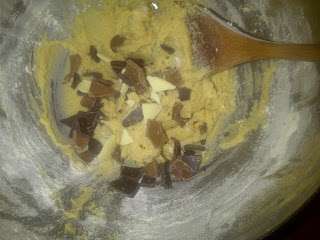
After hosting such an Easter Sunday lunch, we were left with too much chocolate to snack on without feeling sick most of the time. In order to diminish the huge pile, we broke it all up into pieces and put it into cookie dough. The result was a tin full of crispy biscuits not to be gorged on but dipped into mugs of tea gracefully.

Recipe:

110g softened unsalted butter
50g caster sugar
55 light muscovado sugar
1 egg
1/2 a pod's worth of vanilla seeds, or a dash of vanilla extract
110g plain flour
1/2 tsp bicarbonate of soda
150-200g broken up Easter egg chocolate

Preheat the oven to 180 degrees, and grease a few baking sheets. Mix butter and both sugars together until pale and fluffy, then beat in the egg. Add the vanilla before sifting the flour and bicarbonate of soda, and finally incorporate the chunks of chocolate. Spoon the dough out onto baking trays into dollops about 5cm apart, and bake for roughly 10 minutes. The cookies seem far too soft when straight out of the oven, but they will harden soon enough.


Sunday, 3 April 2011

Part Five: Fresh Orange


On the last day of our trip, we were once more pounding the streets right up until dusk. Pausing for a rest, we stepped inside an old juice bar for a burst of fresh vitamin C. All over Cairo, these are almost holes in the wall with one man ready to squeeze seasonal fruit usually using an old-fashioned brass press.


In January, oranges were at their best, proudly hanging in clumps from the ceiling. Of course we had to remember to ask for no sugar to be added, or we wouldn't have tasted the juice at all. We stood at the bar until our glasses were empty (no take-away cups to be seen) then continued on our walk.

Monday, 28 March 2011

Part Four: Karkade


Not drinking a great deal of alcohol, and also avoiding the thick, sickly sweet liquor that passed for coffee, we had become accustomed to confidently requesting 'karkade' as our drink of choice. The tea made from an infusion of petals from the hibiscus flower is deep pink, and has a sour flavour similar to cranberry. It is normally (as with most drinks in Egypt) sweetened with lots of sugar, but I preferred it without. You can almost taste the vitamin C in its tartness.


Memorable occasions of drinking it include our night spent in the middle of the Western desert near the border of Libya, where it was brewed in a kettle nestled amongst burning logs. We also sipped from mugs of it overlooking the Mediterranean in a cafe opposite the great library in Alexandria. It seemed to have become such a part of our trip that when we found this spice shop on our route to the train station in Luxor, we couldn't help buying some to take home. The dark petals were strewn at the back of the shop, and scooped up in to plastic bags for us. Incidentally, we also bought some peanuts from the same shop to snack on which were the best peanuts I have ever had. Now back at home, after a long dinner, it makes for a satisfying ritual to soak and boil the petals and decant the viscous liquid into cups to fuel the rest of the evening.

Tuesday, 15 March 2011

Part Three: Koshari


The first time we ate Koshari was in one of the more fancy dining establishments on Cairo's Zamalek island, a green safe haven between the banks of the Nile, for wealthy ex-pats or ambassadors. There, at Abou-el-Sid restaurant, it was delicious, but from hereafter, we were to find the true experience of it, which I think has a lot to do with the informal, canteen style set up of a classic Koshari house.

With some time to kill before boarding our train from Luxor to Aswan, we found a 'KOSHARI' sign in amongst the string of ahwas, spice shops and (weirdly) lots and lots of chemists on the main drag towards the station. We were greeted with quite a few odd looks, and were apparently very unwelcome sitting in the dark room downstairs so we lugged our big backpacks up to the first floor and took a seat. A waiter soon came to take our order - other than koshari we ordered some lamb shawerma with flatbread. This was good, very juicy and flavoursome however the metal bowl full of carby grains was the highlight. The mixture consists of rice, brown lentils, macaroni and sometimes chickpeas. This is served with a tomato sauce which is to be poured over, and bottles of lemon vinegar and spicier chilli sauce usually adorn tables to add as you like.


On our final day in Egypt, back in Cairo after a week of travelling around the country, we made a koshari pilgrimage to Abou Tarek, one of the most favoured places in the city. At over four storeys high, it seemed that rather than open at multiple locations in the city the building had just grown to accomodate their popularity. The face of Mr. Tarek himself was emblazoned on the sides of the building with a welcoming smile. Even before we entered, we could see the dish being prepared in all its different constituents, having to move out of the way for men carrying huge vats of wobbling pasta from across the street, with piles of pre-crisped onions awaiting being scattered on top.


Each establishment will have its slight variation - here, longer pieces of spaghetti were included making it seem more like a pasta dish than a warm grainy salad. The main dish is usually served in these metal bowls - I liked the flashes of blue on the accompanying crockery. Certainly many Egyptians would call it a national dish, despite its bizarre mixture of elements that make it strikingly multicultural. It is interesting to imagine how the dish came about, other than as the perfect amalgamation of leftovers. The name though relates to the Indian and Pakistani dish Khichri (which gave us our kedgeree), that dates back to the 15th century. Scooping up mouthfuls of it, you can see why the simple combination of seasoned pulses and a variety of bright or spicy additions has crossed continents and stayed popular for so long. Similarly, it is refreshing noticing that despite how cheap it is, the diner-like metal tables of places like Abou Tarek and our Luxor koshari house see a range of customers - families, old men, groups of girls, even well-dressed couples on romantic lunchtime dates. And as we found with our original experience of it, it has even worked its way onto the menus of more up-market locations, perhaps with the same thinking that has brought pork belly, offal and other cheap cuts of meat to the fanciest of London restaurants. Who knows, maybe someone will even open a koshari house there.

Friday, 11 February 2011

Part Two: Sahlab


As dusk approached on our first day in Cairo, we had been pounding the streets, making our way to Khan El-Kalili market. We'd had to ditch the map as the streets we needed were too small to be marked, and therefore got lost in crowds of locals trying to do their weekly shopping. By the time we arrived at El-Fishawi - one of the reasons we were visiting the market - S had been groped by a young boy, we had spent twenty minutes in a traffic jam overlooking the streets, and were very tired. The 'ahwa' was the best place to recover. All over the city, these are simply coffee houses - usually tiny - where tables, chairs, and shisha smoke spill out on to the pavement.

El-Fishawi is perhaps not representative of the typical ahwa, as it is certainly on the tourist trail, but with most streetside examples not welcoming women, we were happy to settle here and ignore market sellers hovering over us with miniature camel toys. We found a couple of free seats, and in our best phrase-book Arabic ordered some mint tea and some 'Sahlab', which we were keen to try as it is a popular drink for winter months. And we soon found out why - it it arrived in a mug, steaming and gloopy. Classically, the drink is made by mixing a flour of ground orchid tuber with sweetened hot milk, often flavoured with orange or rose water. Ours was mixed with dessicated coconut, and had been topped with raisins and peanuts. More of a pudding than a drink, it was incredibly warming and soon became a favourite of mine.

Although sweet, softened by the milk it was one of the few drinks that was not normally rendered ridiculously sugary. The famous 'Egyptian coffee', delivered in small long-handled pots, is concentrated and sweetened so highly that it is hard to think of it as coffee at all. All teas are also customarily sweetened, which was often disappointing if we failed to remember to specify - mint and 'karkade' hibiscus tea are so refreshing without anything added. It seems to be that, contrary to what would probably be the case here, men almost show off with the amount of sugar they add, spooning in heaps one by one as observe the limit of their sweet tooth.

Wednesday, 26 January 2011

Egypt Highlights - Part One: Pigeon soup?


Before Egypt was thrown into revolution, S and I were there making our way around as much of the country as we could in just under two weeks. Our first morning in Cairo was spent slowly wandering round the Egyptian Museum at the edge of Tahrir Square - now virtually unrecognizable underneath the throng of protesters who have made it home for the last couple of weeks. Staring at mummies and walking from one of Tutankhamun's treasures to the next was hungry work, and after leaving we quickly made our way to Emara Hati al-Geish, a kebab shop that has been open since the 1920s. Back then it was apparently called Hati al-Malek (the King's kebab restaurant) but after the 1052 revolution the name changed to 'the Army's...'

We had some excellent grilled lamb chops, and a plate of stuffed vine leaves, but the most unusual element was the complimentary pigeon soup we received as a starter. We had noticed this as the absolutely cheapest thing on the menu when deciding what to order, and wondered what it would be like. We couldn't imagine wild pigeon being used, and couldn't get the idea of street birds out of our minds especially when considering we had not yet got used to constantly breathing in the black smog of Egypt's capital. The soup was essentially a very lemony stock, a nice appetizer to a meaty meal. It reminded me of the Greek 'avgolemono' which is made with chicken. After forgetting the idea of any old dirty pigeon being chucked into a pan, we found pigeon featured on many menus - especially stuffed with rice and herbs - and in fact saw them being sold in markets. It was interesting to see how the bird which to us in England is often found at high-end restaurants as a result of traditional shooting practices at particular times of year, is here practically a staple.

Sunday, 31 October 2010


I've been thinking a lot lately about the idea of generosity and conviviality whilst writing a big essay on Nicolas Bourriaud's theoretical text 'Relational Aesthetics'. It's about art, but in relation to a society that has arguably obstructed human communications with a commerce and has prompted artists since the 90s to create works which find their meaning in the 'relations' they create within a wide audience. I'm particularly interested in the way some artists (Rirkrit Tiravanja to name one) have used food as a medium for this.

Perhaps I'm just noticing it more, but since I've been writing the essay, acts of generosity and food events have come my way which prove that what these artists were/are aiming at highlighting is being done to a small extent in real life. I wrote the other day about the apples that were left on our doorknob, and this became inspiration for a short piece for Eat Me magazine on this theme. The next day as I was walking through the University square with C we were intrigued to see a small crowd around some sort of wooden contraption.

It was a home-made cider press, and the group were trying to get through the mounds apples that surrounded them. We were handed some thick, cloudy brown juice - it was delicious - literally just an apple liquidized. I was told by the friendly girl who seemed to be in charge that this was 'Abundance', and the group had managed to source fruit from apple-growers around the city . As was obvious, there are a lot of people in Edinburgh who happen to host an apple tree in their garden but will never eat the whole harvest. Behind the ethos of the collective lies a generosity of spirit, essentially something which I think should be inherent in the production of food in general - this month further events include Bread Baking and Jam & Chutney. We put the dates in our diary and left with as many apples our bags could fill, then the next night C made the best crumble we've ever had.

London Allotments


Talking of the good life, my friend Edwina has been photographing allotments for years and now has her photos displayed at London's Garden Museum. Anyone in London should have a look for some growing inspiration, it is open every day until 28th November.

Tuesday, 26 October 2010

Belated Eggs


Although very late, I'm putting these photos up so I don't forget them. The other week we had a special delivery of eggs from G whose hens had laid them over in Dumfries. They were too special to use in everyday cooking so I had to try them out at breakfasts in a few different ways:

Scrambled


- plenty of butter
- two eggs barely beaten
- cooked for a few minutes so still creamy
- sourdough toast from Peter's Yard, which I think tastes a bit cardamom-y.

Poached


- shallow pan of water
- no vinegar
- one egg cracked in, simmered for a few minutes
- seeded rye bread from Scott's deli

Baked (made by M)

-cracked into rammekins
- baked in oven for about 8 minutes
- seasoned with s + p
- lots of butter on seeded rye toast

My favourite was the mini one (!). G informed us it would be completely white inside, with no yolk but we never got to try it as it was proudly exhibited in our kitchen for so long. Eggs really are among my favourite things.

Welcome


The absence of recent posts has been due to the fact that my pride and joy of a perfect food-photographing camera decided to self-destruct. Apparently I am more inspired to write about food when the picture is there to remind me of it. I am mourning its loss but there are still lots of things to write about. Since I wrote about Peru, it became autumn in Edinburgh - and what a way it was to be welcomed into the season to find a bag of rosy apples hanging on the doorknob. We have recently moved into the flat so don't yet know the other tenants in the building, so this mysterious gift caused a whole lot of speculation.

R suggested they might be poisoned, but I reminded her we weren't in a fairy tale and the most likely candidate for apple-donation were a mid-50s couple, wife often seen in her dressing gown and husband playing golf nearby. I promptly took a bite. I'd be lying if I said they were the most delicious apples ever (although it really would have made the story), but I'm wondering if we can propose a regular trade-off between any other glut they want to get rid of and compost which we have no garden to feed with. Or have I just stepped from fairy tale into an episode of the Good Life.

Friday, 10 September 2010

Day Two: Barranco (and proof that not only the posh restaurants are good)


On our second day in Lima, J took us to Barranco, a neighbourhood just a bit further south of the centre than Miraflores. Bright colours of the old-style houses were familiar from parts of Miraflores - this was an area of high-end second homes in the 1920s. As Lima sprawled, this cliffside suburban 'holiday resort' was soon engulfed by the city, and so the rich moved elsewhere. Squatters replaced them and the area became known for poverty and dodgy drug deals - not somewhere you would spend a day wandering around in the sun. Recently though, Barranco has shaped up and become home to a bohemian artistic community. Thank goodness - it is beautiful. There is a strong sense of local community - grand old houses are graffitied with 'NO SE VENDE' (not for sale) in the hope that the blossom-filled streets won't be ruined by high-rise blocks, like so much of the rest of Lima.

After walking a while, we stopped for a cerveza at Juanito Bar - a typical old-style venue, apparently a pillar of Barranco among locals. We felt pretty smug being the only tourists there. Unfortunately no pictures of this one but I can remember it well - a narrow room with high ceiling, a bar on the right loaded with hams, pickles etc, and small tables with wooden booths where we sat on the left. Here we just enjoyed a Cusquena, and decided to move on to eat so we had a chance to see more.

The next stop was Casa Rana ('The Singing Frog) - Barranco's equivalent to a local sports bar. It was the World Cup, after all, so we picked a table opposite the big projector screen and watched some football. I would love to go back to Casa Rana. A family run local institution, it had such a great atmosphere, not in the slightest ruined by food which would be the case in any sports bar in this country I'm sure.


We were brought some 'Canchita' - sun-dried and roasted corn kernels, perfectly salty to go with a cold beer. We found these in many more places after this, and became addicted enough to carry some home for others to try. J had told us that a big lunch might not be a good idea as the evening meal would be big again (warned this time!) so Casa Rana was the perfect place, with its list of small tapas bites. We chose 'Conches a la chalaca', clams in a spoon with chalaca style sauce and lots of lime juice as usual. Two mouthfuls of this delicious mixture was all we needed for the rest of the afternoon, and once again I was so excited to have had such amazing food, this time hardly costing anything.


Wednesday, 25 August 2010

Astrid Y Gaston, Lima

You would have thought that such a lunch as we had at El Mercado would have provided enough food excitement for one day. But our friends in Peru were not going to allow one mealtime space to go unfilled with something special. After all, we only had two full days in Lima, and forgetting about any sights, galleries, museums - that's six opportunities for a food-obsessed tourist. We had been hearing stories of Gaston Acurio - probably the biggest name in Peruvian cuisine and responsible for placing the country firmly on the food map - so were amazed to find ourselves staring at his name on a plaque outside tonight's surprise restaurant. This was Acurio's first restaurant, which he opened with his wife Astrid, who was a pastry chef at the Cordon Bleu.

We entered the restaurant through its grand door of old-style Miraflores into a cozy bar area where we waited for our table. First things first, Pisco sours all round. As the days went on, we became hopelessly addicted to this Peruvian national drink in its simplicity and deliciousness. Pisco (a grape-based spirit) is mixed with sugar syrup and plenty of lime juice, then whizzed up with egg white which forms the frothy top layer, speckled with a few droplets of Angostura bitters. The cocktail menu here was very exciting, with many variations on the classic sour, so we had to try a few such as Tumbo sour.

Unfortunately my camera battery died during cocktail hour so I had to resort to phone pictures for the rest of the meal (rookie error I know). But I did quite well despite the low lighting - anyway it is not so much a matter of whether the food looks good but the number of pictures indicating just how much food we ate.

And so we were seated at our table, nestled in the corner of a room lined with wine bottles, about to be presented with some of the most impressive creations I have ever eaten. First, the bread. I don't normally like to eat much bread when dining out in case it fills me up but this array was completely appealing - six different types, ranging from one made with chocolate to a brioche studded with more of that Peruvian mint. It was becoming evident that Astrid y Gaston was not the kind of place to simply have a starter, main and dessert and be done with it.

Alongside the bread came a plate of 'house starters': a shot glass of Oyuco syrup and Huacatay foam, a tiny seafood pastry, and Peruvian corn tempura. The corn I was particularly fascinated by - to me it really felt like eating an ancient grain. With a satisfying earthy flavour, it did not taste like ordinary sweet yellow corn, and neither looked like it with its huge, long white kernels.

Lines of this corn can be seen more clearly, placed on top of a fish ceviche, one of the starters we actually ordered. This looked beautiful, with rounds of spring onion and chilli floating in the familiar 'tiger's milk'. It tasted amazing and I had stop myself eating more than a spoonful to allow room for the other dishes - octopus, grilled and charcoaly and a scallop with sweet potato and brown butter, leeks and chilli. The varying ways of eating a single scallop were proving to be incredibly exciting.

By this point I was actually starting to feel quite ill from having eaten so much food that day, and this was tragic given the amount of food that was left to come. Mum and I had decided to go halves on suckling goat with pureed pumpkin, and Mero fish - a local speciality. Both were delicious, but I regret I could merely sample a few mouthfuls of each before entering into a state of anxiety that I might have to absent myself from the table to go and lie down somewhere.


Fortunately, my appetite miraculously returned in time for dessert, when the most adorable jewellery-box arrived with drawers of petit-fours: a pea green coca biscuit dulche de leche sandwich was my favourite, but everything was so beautifully crafted (this must be Astrid's influence): mini macaroons, triffles, and pineapple-flavoured sugared jelly cubes.


The desserts we'd actually ordered (!) were baked apple with caramel, cardamom and ginger ice cream (delicous as it sounds), and a ball of Lucuma ice cream inside a chocolate ball, which was made at the table by pouring over molten chocolate. The lucuma flavour (quite maple-y as in the desserts at Mercado) made for really interesting ice cream, and went very well with chocolate, in a way that pear and almond does.


Even with being far too full most of the way through, almost nauseous at one point, I can honestly say this could rank as one of the best meals I've ever had. Nothing was boring - a good proportion were unlike anything I've ever had. What a great showcase for a national cuisine. Obviously Astrid y Gaston is an expensive restaurant, and I'm not suggesting that it is representative of what people eat on a day to day basis, but it appears that Gaston Acurio has a healthy interest in truly local food, having made television programmes scouring the country for its best cevicheria, and having made a name for himself internationally promoting Peruvian food. We were so lucky to have been taken to this fantastic restaurant - it only increased my appetite (NOT literally - I couldn't eat breakfast the next morning) for knowledge about Peruvian food and its traditions.

Monday, 2 August 2010

Sunday, 1 August 2010

El Mercado, Lima, Peru


We had arrived in Lima the previous night, and were met by our friends who immediately whisked us away from our hotel for to begin the race to fill our short time in the city with as much food as possible. High standards had been set by our first Pisco sours, some barbequed seafood and beautiful quails egg toasts at la Gloria, a late-night bar in Miraflores. The first full day started with a walk around the neighbourhood, which ended at the newly opened El Mercado where we were to dine - amongst Lima's trendiest, it seemed.

El Mercado simply means 'the market', and was supposed to be a laid back, pared down offering from one of Lima's most prestigious chefs, Rafael Osterling. It was nicely informal
- the whole restaurant was separated from the street by only one wall, so dining was almost open air. We were presented with some very real-looking potato chips and different dips: one with aji amarillo (yellow pepper) and 'Huacatay', a kind of local mint, and 'Huancaina', made with white cheese and more aji. Washed down with a Cusquena beer, these were a fantastic example of local ingredients being used so cleverly in simply things.


Jonathan and Carmen had taken charge of the ordering, which we were grateful of as more delicious plates arrived. Octopus with tomatoes and potatoes was char-grilled and absolutely fresh from the sea. We forked up mouthfuls straight from the hot plate until it was gone. The ceviche was perfectly limey - probably one of my favourite flavours. It was nice to try it with lightly fried calimari as opposed to raw fish; the crispy tentacles made for interesting texture, especially combined with chunks of sweet potato nestled in the pile. The juice left at the end is deliciously sour and fishy - it is called 'tiger's milk', and apparently it is common procedure to ask for it to be brought back to your table, mixed with pisco in a shot glass.


The selection of scallops was probably the most exciting dish we had - Bloody Mary flavour was fantastic, tasting as you would imagine it to with a teeny chunk of avocado. It was the first time I'd eaten raw scallops, and having wallowed in juices in their shells, they melted in the mouth.


Last on our list was Jalea, a typical dish of deep fried seafood, here served with a sort of creole sauce and lime. I loved how colourful and fresh everything was. The concept of the restaurant, as a local 'cevicheria' was so brilliant it's a shame this kind of Peruvian food has not been introduced to London, when so much other world cuisine has taken off. Although, as we lamented, to have such good fish this fresh would be double the price, so the idea of a casual 'market' restaurant would be lost.


Finally, for dessert, variations on the classic Suspiro - the 'Limenian sigh'. It is a sticky cream made from condensed milk, eggs and cinnamon, topped with a port-flavoured egg white foam. It was interesting that the three looked almost exactly the same, although were quite different - aside the 'classico' we had custard apple and lucuma, a tropical fruit that tastes like maple and sweet squash.

Once we had finished, Jonathan pointed out that although we were stuffed full, most people would have had this as a selection of starters, before moving on to mains. It would have been nice to have had the capacity to eat more, but for now we were satisfied with our first real taste of Peru lingering for the rest of the day - until the next meal.


Friday, 23 July 2010

A weekend in New York: Part II (A wedding menu)


I did have more fun at my cousin's wedding than eating dinner, but it's worth noting the meal, if only to provide the next wedding I attend with something to live up to. Everyone, sweltering in their summer best on the evening of June 19th, made their way to be seated around white-clad tables. We were greeted by a pocket-sized box of tea, which we tried the next day and despite smelling too vanilla sweet, was very refreshing but comforting: 'A tea for marriage', as it was labelled.


Beatifully matching the array of bridal pastels, the first course was a cold courgette and buttermilk soup, scattered with radishes and chives like pink and green confetti. It was so delicious that one guest asked for a second helping, threatening to completely scupper the catering staff's deft preparation.


Unfortunately the main course of pink lamb cutlets did not survive in photographic memory, as the emotional distractions of a first dance and some tear-jerking speeches left me unable to tell see whether a photo was in focus or not. Finally out came slices of chocolate wedding cake - the best variety, I would have thought. By this time people had started dancing and switching seats - unwanted morsels of cake seemed to be enough to fuel the evening to its end, via a fair amount of Frank Sinatra kareoke and catching fireflies.